How To Reconstitute Cjc 1295 Ipamorelin 5Mg How Much BAC Water for 10mg CJC 1295? Reconstitution ...
\nHow Much BAC Water for 10mg CJC 1295? Reconstitution Guide
\n\nIf you have recently transitioned from standard 2mg or 5mg peptide vials to a larger 10mg variant, you have likely realized that the math changes completely. For many fitness and wellness enthusiasts in the 25-34 age bracket, the primary point of confusion lies in fluid dynamics. Searching for How Much BAC Water for 10mg CJC 1295? Reconstitution protocols yields highly fragmented answers across forums and subreddits. Some users recommend 2mL, others insist on 3mL, and a few suggest complex dilutions that leave beginners staring blankly at their insulin syringes.
\n\nThe intent behind this search is simple: accuracy. Because CJC-1295 is highly potent, a slight mathematical miscalculation can mean the difference between administering an intended 100mcg dose or accidentally introducing 1,000mcg into an experimental environment. This guide serves as an objective consumer review and instructional breakdown of the reconstitution process, providing exact measurements, real-world case studies, and practical frameworks to remove the guesswork from your laboratory setup.
\n\nWhat a 10mg CJC-1295 Vial Is and Who It Might Fit Best
\nCJC-1295 is a synthetic analog of Growth Hormone Releasing Hormone (GHRH). In the scientific literature, it exists in two primary modifications: CJC-1295 with DAC (Drug Affinity Complex) and CJC-1295 without DAC (frequently referred to as Mod GRF 1-29). The core function of this peptide is to stimulate the anterior pituitary gland to secrete growth hormone via pulsatile releases (for Mod GRF) or continuous elevation (for versions containing DAC).
\nThis compound typically attracts individuals within the 25-34 demographic who are focused on optimizing body composition, accelerating exercise recovery, or investigating age-management protocols. It is ideally suited for meticulous self-directed researchers who understand that peptides are not magic pills, but biochemical tools requiring exact handling. It is definitely not suitable for anyone looking for immediate, steroid-like visual transformations, nor is it intended for individuals who lack the patience to perform precise fluid measurements or maintain sterile laboratory practices.
\n\nPractical Benefits and Where It Falls Short
\nFrom a practical consumer perspective, purchasing a 10mg vial offers clear advantages, primarily relating to cost efficiency and longevity. Buying in bulk reduces the cost per milligram significantly compared to smaller vials. However, these benefits are coupled with distinct logistical drawbacks that many reviews gloss over.
\n \nThe Positives (A Consumer Case): Take the experience of Marcus, a 31-year-old amateur athlete. Marcus purchased a 10mg vial of CJC-1295 without DAC to run a consistent 8-week research protocol. By adding exactly 4mL of bacteriostatic (BAC) water, he created a highly manageable concentration where a standard 100mcg dose aligned perfectly with a specific tick mark on his U-100 syringe. Over two months, he noted steady improvements in deep sleep metrics via his wearable tracker and a more predictable recovery time after intense lower-body training sessions. For Marcus, the larger vial minimized package deliveries and lowered his overall spending by roughly 30% compared to buying 2mg vials.
\n\nThe Negatives (A Failure Case): Conversely, consider the case of Dave, a 26-year-old beginner who did not research the details of how much BAC water for 10mg CJC 1295 reconstitution prior to mixing. Dave haphazardly added only 1mL of BAC water to his 10mg vial, creating an incredibly concentrated solution. Because the liquid volume was so small, a single microscopic tick mark on his syringe equaled 1,000mcg. On his first attempt, his hand slipped slightly, resulting in an massive accidental overdose. Within minutes, Dave experienced severe head rushes, a pounding heart rate, intense facial flushing, and extreme lethargy that ruined his productivity for the day. Furthermore, because he kept touching the rubber stopper with unsterilized fingers, the highly concentrated vial degraded and became cloudy within two weeks, forcing him to discard $70 worth of product.
\n\n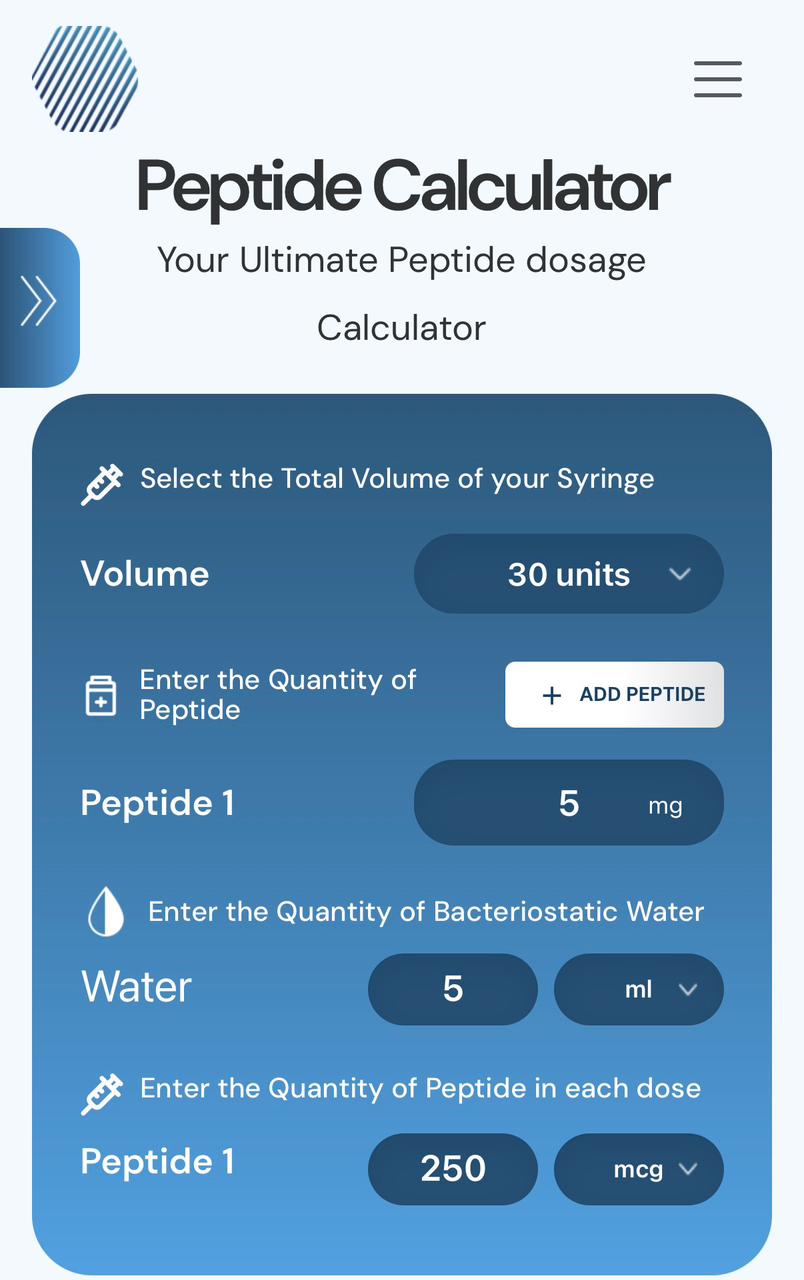 \n
\n What Research Suggests and What It Doesn\'t
\nClinical data regarding GHRH analogs indicates that they effectively elevate plasma growth hormone and IGF-1 levels in animal and human test models. However, it is vital to separate clinical facts from marketing hyperbole. The research does not support the claim that CJC-1295 will cause effortless fat loss or massive muscle hypertrophy in the absence of a calibrated diet and rigorous training program.
\nFurthermore, the risks are real. Documented side effects include transient redness and itching at the injection site, water retention, mild joint discomfort, and temporary insulin resistance if used continuously without breaks. It is critical to recognize that long-term human data on the prolonged use of the DAC version is sparse, meaning caution and regular blood markers are imperative for anyone conducting these evaluations.
\n\nIngredients, Formats, and Quality Signals
\nWhen buying CJC-1295, you are purchasing a lyophilized (freeze-dried) white powder. A high-quality vial should contain only two ingredients: the purified peptide acetate salt itself and occasionally a small amount of mannitol, which acts as a bulking agent to stabilize the cake appearance of the powder during freeze-drying.
\nQuality signals are the most important factor when choosing an online vendor. Reputable sources always provide a batch-specific, independent third-party Certificate of Analysis (CoA) verified by High-Performance Liquid Chromatography (HPLC) and Mass Spectrometry (MS). You should look for a purity rating of 98% or higher. If a vendor hides their CoAs or displays certificates that are more than a few months old, consider it a major red flag regarding purity and structural integrity.
\n\n \n\nComparison of Common Options
\nTo help visualize how to handle a 10mg vial compared to other alternatives available on the market, look closely at the data matrix below:
\n\n| Format | \nTypical Dose/Use | \nPros | \nCons | \nCost (Est.) | \nBest For | \n
|---|---|---|---|---|---|
| 2mg Lyophilized Vial | \n100mcg 1-3x daily | \nEasy math; low waste risk if contaminated | \nRequires frequent re-ordering; higher cost per mg | \n$25 - $35 | \nBeginners testing tolerance | \n
| 5mg Lyophilized Vial | \n100mcg - 200mcg daily | \nGood balance of cost and product lifespan | \nMath requires more attention than 2mg vials | \n$45 - $55 | \nIntermediate researchers | \n
| 10mg Lyophilized Vial | \n100mcg - 200mcg daily | \nBest cost efficiency; lasts through long protocols | \nRequires large BAC volume; high loss if spoiled | \n$70 - $95 | \nExperienced users with steady protocols | \n
| Pre-Mixed Nasal Sprays | \nVaries by spray count | \nNo needles or reconstitution math required | \nExtremely poor bioavailability; rapid degradation | \n$60 - $80 | \nThose averse to traditional research methods | \n
| Oral/Capsule Peptides | \nVaries wildly | \nConvenient oral delivery | \nCJC-1295 is destroyed by gastric enzymes; highly ineffective | \n$50 - $90 | \nNot recommended due to lack of efficacy | \n
Buying Framework and Red Flags
\nBefore purchasing any reconstitution liquids or peptides, walk through this systematic checklist to ensure you aren\'t wasting capital or risking health:
\n- \n
- Verify the CoA Date: Ensure the HPLC report matches the exact batch number printed on your 10mg vial wrapper. \n
- Check for Visual Abnormalities: The lyophilized cake should be solid or lightly cracked white powder. Avoid vials with discolored, yellowing, or gooey contents. \n
- Confirm Vendor Transparency: Legitimate research companies do not use aggressive marketing tactics, obscure payment methods, or make explicit promises regarding human cure or disease treatment. \n
- Source Genuine Bacteriostatic Water: Never substitute distilled or sterile water for BAC water. Genuine BAC water contains 0.9% benzyl alcohol, which prevents bacterial growth in your multi-dose vial for up to 28 days when refrigerated. \n
 \n
\n Common Mistakes and How to Avoid Them
\nThe single biggest mistake researchers make during the how much BAC water for 10mg CJC 1295 reconstitution process is rushing the fluid introduction. Peptides are fragile chains of amino acids held together by sensitive bonds. If you blast bacteriostatic water directly onto the lyophilized powder using high pressure from the syringe plunger, you risk shearing the molecules, rendering the batch completely useless.
\nTo avoid this, aim the needle tip against the inside glass wall of the vial. Allow the vacuum pressure of the vial to draw the BAC water in slowly, letting it cascade down the side naturally. Once the fluid is completely inside, do not shake the vial vigorously. Instead, gently swirl the vial between your thumb and forefinger until the solution becomes completely clear and uniform.
\n\nFAQ
\nIs it proven that changing the volume of BAC water alters peptide potency?
\nNo, altering the volume of bacteriostatic water does not change the total amount of active peptide within the vial. However, it changes the concentration per unit on your syringe. Adding more fluid makes the solution less concentrated, which actually makes it easier to measure precise, small doses accurately without making mistakes.
\n\nHow long does it take to see tangible results from a proper protocol?
\nIn most research settings, minor improvements in sleep quality and muscle recovery are noted within the first 2 to 3 weeks. However, notable changes in body composition or physical endurance typically require 8 to 12 weeks of consistent, disciplined application alongside proper metabolic and training frameworks.
\n\nWhat are the primary side effects of improper reconstitution or dosing?
\nIf you accidentally administer an excessive dose due to improper math, you may experience immediate face flushing, severe head rushes, lethargy, fluid retention in the wrists or ankles, and increased hunger. Maintaining a sterile field during mixing is also critical to avoid micro-bacterial contamination and subsequent injection site infections.
\n\nCan it combine with other GHRP compounds in the same syringe?
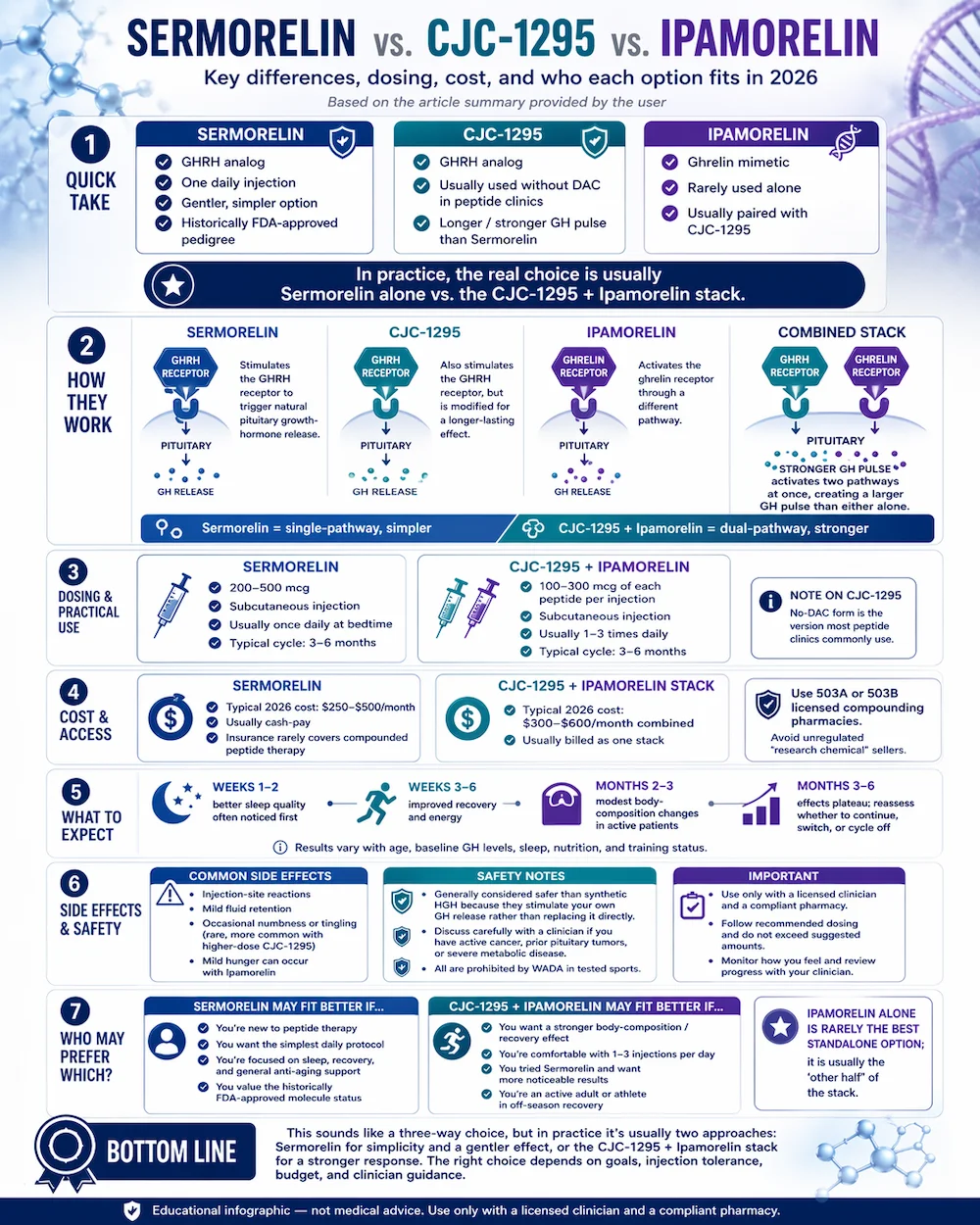
\nYes, CJC-1295 without DAC is frequently combined with a Growth Hormone Releasing Peptide like Ipamorelin to leverage a synergistic effect on GH release. While they can be drawn into the same syringe immediately prior to application, they should always be stored in separate vials to prevent unexpected cross-reactions or degradation over time.
\n\nIs there a viable oral vs injection/alternative option for 10mg vials?
\nWhen studying pure CJC-1295, subcutaneous injection remains the only highly bioavailable method. Oral capsules are almost entirely destroyed by systemic digestive enzymes, and nasal sprays display incredibly low absorption rates. For accurate research data, the reconstituted injectable liquid remains the gold standard format.
\n\n \n\nA Practical 2-Week Experiment Framework
\nIf you are looking to verify your reconstitution math and assess the stability of your mixed solution, follow this strict, conservative 14-day tracking framework. This structure assumes you have reconstituted a 10mg vial with 4mL of BAC water, yielding a clean concentration of 250mcg per 10 units (0.1mL) on a standard syringe.
\n \nDays 1-3 (Baseline Math & Tolerance Verification): Administer a minimal test dose (e.g., 50mcg or 2 units) to observe the subject\'s baseline response. Document any immediate physiological markers such as localized skin redness, itching, or transient flushing. If any unexpected systemic irritation occurs, pause the protocol immediately.
\n \nDays 4-7 (Standardization Phase): Adjust the measurement to your target research dose (e.g., 100mcg or 4 units). Ensure the injection occurs at the exact same time each day, preferably on an empty stomach to avoid interference from circulating blood glucose or lipids. Note sleep quality indices and morning recovery markers daily.
\n \nDays 8-14 (Stability & Consistency Assessment): Inspect the vial daily under direct light before drawing. Check for cloudiness, particulate suspension, or changes in fluid consistency. If the solution remains crystal clear and your logged metrics show steady, predictable trends without increased side effects, your reconstitution configuration is stable and verified.
\n\nAbout the Author
\nEthan Vance is a veteran independent laboratory analyst and consumer product reviewer specializing in metabolic health options and peptide research protocols. Over the past seven years, Ethan has reviewed dozens of research chemical brands, evaluated automated dosing calculators, and authored evidence-based guides designed to promote laboratory safety and consumer transparency.
\nDisclaimer: The information contained in this article is for educational, informational, and research tracking purposes only. CJC-1295 is classified as a research chemical and is not approved by the FDA for human consumption or the treatment, cure, or prevention of any medical condition or disease. Always consult with a licensed medical professional before interacting with any experimental compounds.
\n
Discussion